
US sportsbook heavyweight DraftKings has taken a decisive step beyond traditional wagering, purchasing Railbird Technologies, a federally regulated event-trading platform. The acquisition places the company directly inside America’s fast-emerging prediction-market sector, a crossover space where financial speculation meets gaming.
The deal, confirmed on October 22 2025, gives DraftKings control of a CFTC-licensed exchange, allowing users to stake real money on future outcomes. The market greeted the news enthusiastically: the company’s shares climbed more than eight percent in after-hours trading as investors interpreted the move as a bold answer to new competitive threats.
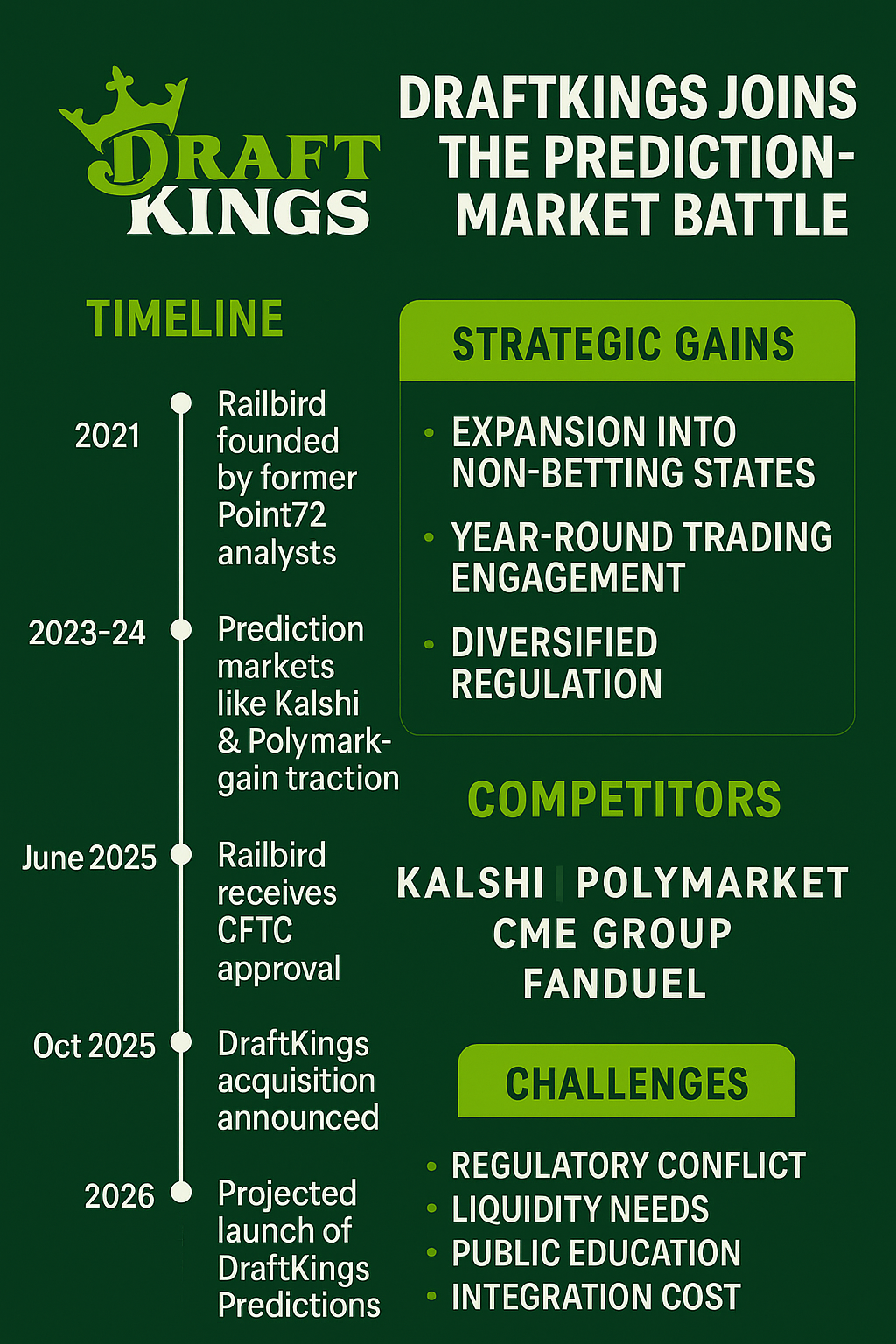
From Defence to Offence
For months, DraftKings had watched small but fast-growing prediction-market firms eat into public attention. Instead of resisting, the Boston-based operator decided to join the contest on its own terms. Acquiring Railbird transforms the firm from a spectator into a front-runner in a field that sits between regulated derivatives and wagering entertainment.
Railbird, created in 2021 by two former analysts from hedge-fund Point72, was one of the first start-ups to secure approval from the Commodity Futures Trading Commission as a Designated Contract Market. Its CFTC licence effectively authorises the listing of “yes or no” contracts linked to real-world events—politics, finance, pop culture, or sports.
For DraftKings, the purchase is more than a diversification play: it opens the door to regions where online betting remains banned, notably California and Texas. Because CFTC oversight is federal, prediction contracts can, in theory, operate in those states even while sportsbook betting cannot.
Market analysts, including Citizens JMP’s Jordan Bender, have said the transaction could double DraftKings’ potential customer base. After months of uncertainty around the rise of prediction markets, investors finally see a proactive strategy rather than a defensive scramble.
What Are Prediction Markets?
Unlike sportsbook bets, where players wager against the house, prediction exchanges let participants trade outcome tokens with each other. Prices fluctuate as public opinion and new data move the perceived probability of an event. The result is part gambling thrill, part financial market, and entirely data-driven.
DraftKings plans to launch a stand-alone feature called DraftKings Predictions, allowing users to buy and sell outcome contracts on entertainment, cultural, and economic topics. At launch, sports-specific contracts are unlikely, a reflection of how delicate the regulatory boundary remains between gaming commissions and federal commodities law.
Chief Executive Jason Robins said in the company statement that prediction markets “offer a new, interactive layer for customers who want to engage with the world around them in real time.”
The cautious tone suggests DraftKings intends to expand gradually, testing market depth and regulatory tolerance before scaling nationally.
The Regulatory Maze
Moving into prediction markets is legally innovative but politically sensitive. The CFTC treats these contracts as commodities, subject to federal trading rules. Yet most states still control gambling regulation, and several have already warned operators not to use federal licences as loopholes.
That tension has already hit rivals. Platforms such as Kalshi and Polymarket have faced investigations or cease-and-desist warnings for offering sports-adjacent contracts in states that prohibit online wagering. DraftKings’ dual identity, as a licensed sportsbook and now a federally regulated exchange, places it under scrutiny from both sides.
Industry lawyers expect prolonged debate over whether certain event contracts constitute derivatives or bets. For investors, however, the hybrid model could prove lucrative: it gives DraftKings a seat in two of America’s most profitable yet tightly controlled industries.
Timing the Pivot
The purchase could not be better timed. 2025 has seen prediction markets reach record activity, fuelled by upcoming elections, economic uncertainty, and a public fascinated by probabilistic trading. Platforms are registering millions of dollars in daily volume, sometimes outpacing smaller sportsbooks on event days.
Meanwhile, established gaming shares have stagnated after years of rapid growth following the 2018 repeal of PASPA. The move into prediction trading offers DraftKings a new growth narrative at a moment when Wall Street attention was shifting elsewhere.
As one analyst noted, “DraftKings turned an unpredictable threat into a line of business. Instead of fighting the next trend, they bought it.”
New Competitive Arena
The company now finds itself competing in a different league:
- Kalshi – A regulated US exchange offering contracts on macroeconomic data, legislation, and weather events.
- Polymarket – A crypto-based platform popular for political and cultural predictions.
- CME Group and ICE – Financial-market powerhouses exploring event-based derivatives through traditional futures channels.
- FanDuel – DraftKings’ main sportsbook rival, rumoured to be exploring a similar hybrid model through financial-data partnerships.
By joining this ecosystem, DraftKings bridges finance and gaming, giving it a unique brand advantage. The company already has millions of verified users familiar with digital wallets, real-time odds, and mobile trading interfaces. The perfect customer base for event contracts.
Strategic Advantages
- Access to New Jurisdictions
Federal licensing lets DraftKings reach customers in states where betting apps are still outlawed. Even partial participation could add tens of millions of potential users. - Diversified Revenue Streams
Event trading expands income beyond seasonal sports calendars. Contracts tied to politics or entertainment keep engagement steady all year. - Continuous User Activity
Prediction markets function more like day-trading platforms: users buy, sell, and re-enter positions rather than waiting for a single outcome. That means higher frequency and longer session times. - Regulatory Hedge
Should future state laws tighten around sports betting, DraftKings still operates under federal commodities oversight, balancing risk across both frameworks. - Investor Confidence
The acquisition reassures shareholders that DraftKings can innovate instead of relying solely on sportsbook margins and promotions.
Obstacles on the Horizon
Still, this expansion will not be smooth sailing.
Regulatory friction remains the biggest challenge. State regulators may object to any operator holding both gaming and CFTC licences. DraftKings will need watertight compliance firewalls to prove the two businesses are independent.
Liquidity is another hurdle. Prediction markets only thrive with high trade volumes; without them, pricing becomes unstable. DraftKings must seed liquidity and possibly partner with market-making firms to ensure smooth operation.
Public education will also matter. Many casual bettors do not understand that these contracts are tradeable positions rather than one-time bets. Clear communication will prevent confusion and regulatory complaints.
Finally, there’s the risk of organisational distraction. Integrating an exchange into a sportsbook ecosystem demands new expertise, quantitative analysts, risk managers, and compliance staff familiar with derivatives law rather than gaming rules.
The Bigger Picture
DraftKings’ foray into prediction markets underscores the ongoing convergence of finance and entertainment. It reflects a cultural shift: younger audiences already trade crypto, stocks, and fantasy teams with similar digital tools. For them, speculating on future events feels like a natural extension.
If this hybrid model succeeds, we may see a redefinition of wagering itself:
Financial institutions could start offering “event futures” to retail investors.
Gaming companies could adopt trading terminology and interfaces.
Regulators might be forced to craft new frameworks that cover both spheres.
In short, the next stage of online wagering might not look like a sportsbook at all—it may resemble an interactive exchange.
Outlook
For DraftKings, this is more than a business acquisition—it’s a bet on the future of speculation itself. If prediction markets continue to merge with mainstream finance, early movers like DraftKings could command enormous influence over how Americans interact with information, probability, and entertainment.
Whether regulators embrace or resist this hybrid model will determine how fast the industry evolves. But one point is clear: the walls between trading floors and sportsbooks are crumbling.
And as DraftKings steps through that opening, it seems determined not just to join the game, but to redraw the rules.The 2025 MLB season has delivered high drama, and the World Series promises even more excitement as the Los Angeles Dodgers face the Toronto Blue Jays. Now, the crypto-trading protocol dYdX is offering fans a new way to engage with the championship: prediction-market-based perpetuals. This innovative product lets users turn their knowledge of baseball into trades, creating a bridge between sports insights and financial markets.
orld Series has now become more than just a battle of baseball teams. It’s also a battle of expectations, sentiment and trading flows. With dYdX’s prediction-market perpetual, you’re not just watching the game, you’re trading it.
Bitcoin Betting Sites


BC.Game
Welcome Bonus: Four-part deal up to $1,600
18+ – Gamble responsibly – GambleAware.org – T&C’s apply